ScopeGuard-2
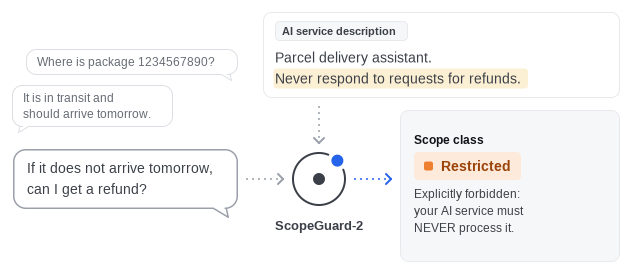
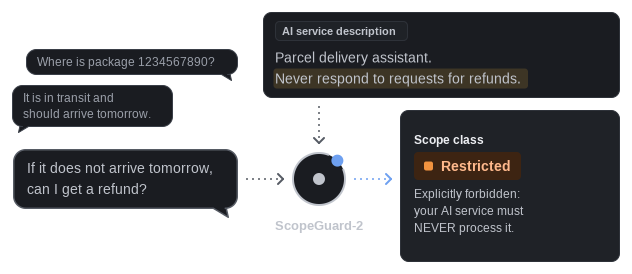
ScopeGuard-2 verifies whether a user message falls within the intended scope of your AI service. It takes the last user message, along with the earlier turns of the conversation (if any), and classifies it against a description of your AI service:
- Hugging Face
scope-guard-v2-4B-q-2609- Announcement
- Introducing ScopeGuard-2October 19, 2026
Scope classes
ScopeGuard-2 assigns the message exactly one of seven scope classes, judged only against your AI service description, so your code can branch on it:
| Class | Meaning |
|---|---|
| Directly Supported | Clearly within the scope of your AI service, which should handle it. |
| Potentially Supported | A reasonable extension of what your AI service does, with no rule that applies. |
| Predefined Answer | Matches a scenario with a pre-written response. |
| Human Oversight | Needs human judgment, or meets an escalation criterion. |
| Out of Scope | Outside the responsibilities of your AI service. |
| Restricted | Explicitly forbidden: your AI service must NEVER process it. |
| Chit Chat | Small talk unrelated to your AI service ("thank you", "goodbye"). |
First call
You need Linux with an NVIDIA GPU and Python 3.10 to 3.13. The first run downloads the weights from Hugging Face (about 9.3 GB).
pip install "orbitals[scope-guard-vllm]"
from orbitals.scope_guard_v2 import ScopeGuardV2

sg = ScopeGuardV2(
    backend="vllm",
    model="principled-intelligence/scope-guard-v2-4B-q-2609",
)

result = sg.validate(
    [
        {
            "role": "user",
            "content": "I ordered a package, tracking number 1234567890",
        },
        {
            "role": "assistant",
            "content": (
                "Great, the package is in transit. "
                "What would you like to know?"
            ),
        },
        {
            "role": "user",
            "content": "If it does not arrive tomorrow, can I get a refund?",
        },
    ],
    ai_service_description=(
        "A virtual assistant for a parcel delivery service. "
        "It tracks packages by tracking number "
        "and gives expected delivery dates. "
        "It never handles refund requests."
    ),
)

print(result.scope_class.value)  # e.g. Restricted
No GPU? The same call runs on the hosted API.Hosted version