ClaimExtractor
ClaimExtractor reads a conversation and extracts two structured outputs from the last message of the conversation:
- claims: factual statements, labelled with one of four subtypes;
- intents (only if the message is a user message): explicit goals, requests, or actions the user wants to accomplish
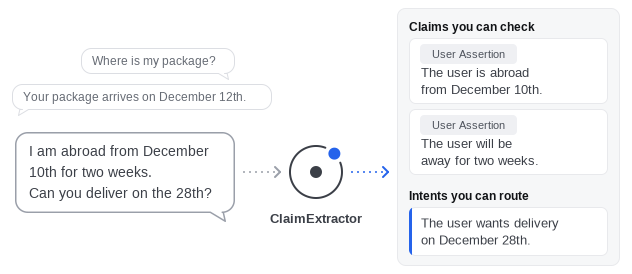
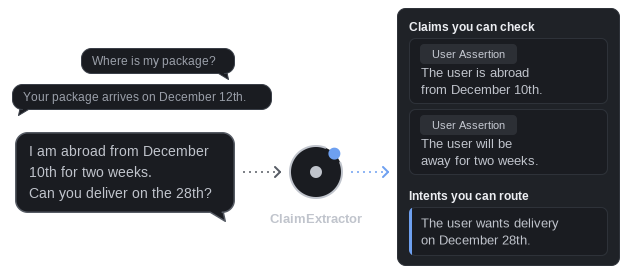
Each extraction is decontextualized: it stands on its own without reference to the surrounding conversation, so it can be consumed directly by fact-checkers, intent routers, hallucination detectors, and audit pipelines without re-parsing history.
If you have a description of your AI service, pass it too: it is optional, but it improves the extractions, Capability claims above all. Plain text works, and the library's structured AIServiceDescription works best.
- Announcement
- ClaimExtractor: Turning AI Conversations into Auditable Claims and IntentsJune 4, 2026
Claim subtypes
Each claim comes with one of four subtypes, which tells you what to check:
| Subtype | What it covers |
|---|---|
| Factoid | Verifiable facts about the world: dates, prices, procedures, locations, contact details. From either role. |
| Capability | What the AI service can or cannot do, mostly stated by the assistant. |
| User Assertion | Facts the user states about their own situation ("my ID expired"). User messages only. |
| Unverifiable | Common knowledge, opinions, marketing language, hedged predictions: tagged, not dropped. |
ClaimExtractor verifies nothing: checking Factoid and Capability claims against your sources is your step.
Intents
ClaimExtractor returns one intent for each request the user states, and none for assistant messages. The request has to be stated: "I have a dog" is a User Assertion, with no intent expressed.
- Claims
- User AssertionThe user is travelling abroad starting from December 10th.
- User AssertionThe user will be away for two weeks.
- Intents
- The user wants to reschedule the delivery of their package to December 28th.
- The user wants the parcel delivery service to email them a receipt.
First call
You need Linux with an NVIDIA GPU and Python 3.10 to 3.13. The first run downloads the weights from Hugging Face (about 9.3 GB for the 4B).
pip install "orbitals[claim-extractor-vllm]"
from orbitals.claim_extractor import ClaimExtractor

ce = ClaimExtractor(
    backend="vllm",
    model="principled-intelligence/claim-extractor-4B-q-2605",
)

output = ce.extract(
    [
        {"role": "user", "content": "Do you offer express delivery to Milan?"},
        {
            "role": "assistant",
            "content": (
                "Yes: express delivery to Milan costs 9.90 euros "
                "and arrives the next business day. "
                "I can also upgrade an order you already placed, "
                "if you send me its tracking number."
            ),
        },
    ],
)

for claim in output.extractions.claims:
    print(claim.subtype, claim.content)
# e.g. Factoid Express delivery to Milan costs 9.90 euros.